ENG | Zebralight H53c headlamp review
Zebralight H53c headlamp review: great color, tiny size, ruined by a narrow beam and a bad strap piece.
Petzl Tikkina
This was my previous headlamp. I’m mentioning it, because it inspired me to buy something better.
I had this for a long time. Alkaline batteries, quite comfortable, all plastic. Awful light quality, all pinkish or blueish gray. I probably had a Petzl Tikka before since like 2005, which I assume I lost. This headlamp died, likely due to leakage of alkaline batteries. If I recall, it had two power modes and inspired me on what not to buy. Served the purpose, nothing more. Despite using the Petzl Tikkina with alkaline batteries probably the most, together with some no-name headlamp, I somehow don’t recall any issues with runtime or not having enough light. I had issues with durability and awful color rendition.
Zebralight H53c
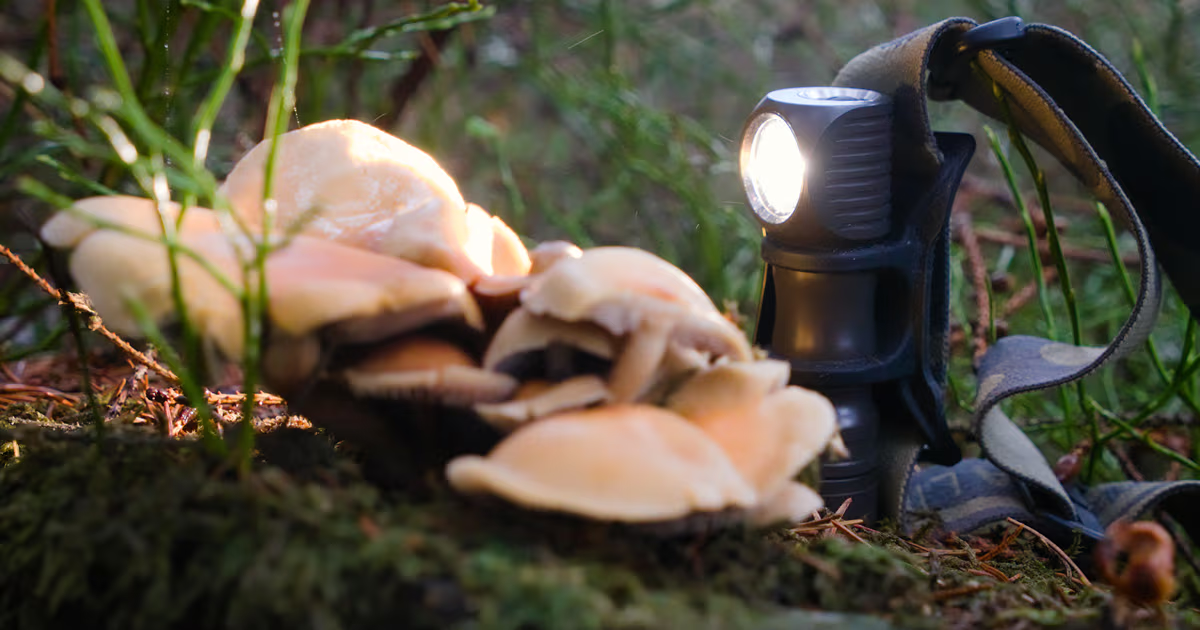
I bought this headlamp based on YouTube reviews and I wanted to avoid things I don’t like about the Petzl Tikkina bought roughly in 2010 - which is comfortable, but plastic, light quality is awful (basically everything seems gray with tints of blue or pink, only blue stands out), and does not really have a low light or red light mode. I don’t trust all plastic Petzl on cross-country skiing, I broke some no-name headlamp with a reflector before.
My thoughts about Zebralight (model released in 2017)
Pros:
- Durable
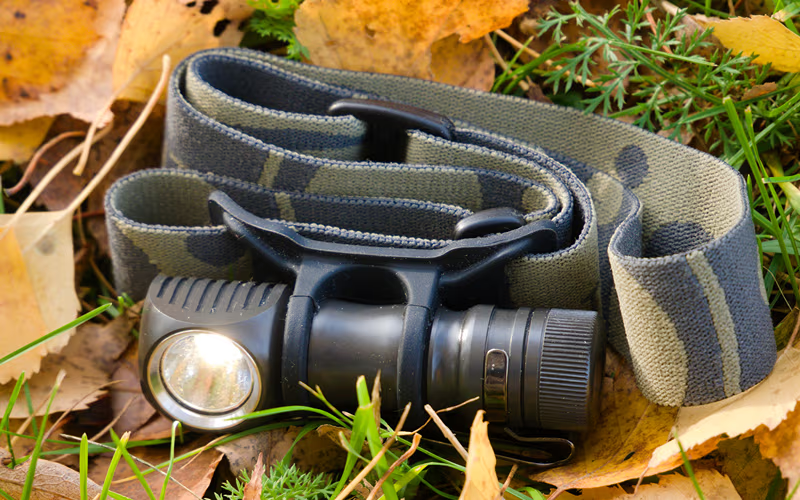
- Lightweight and tiny (84g with headband)
- Great light quality
- Six intensities (programmable), low modes
- Cree XP-L2 LED emitter, 4000K, 93-95 CRI, 285lm max
Cons:
- Battery duration, although I never needed more than maybe two hours
- Headband - soft rubber is bent against forehead, after rerouting it does not hold the headlamp tight enough
- Too narrow cone with hard transition to spill (which also shifts towards cooler light)
- Blinks when battery is drained and headlamp is off (normally that blink signals that battery is inserted and cap is tight)
- Very expensive at roughly 1300czk (55 or 60eur?) in 2018, plus shipping fee from Netherlands
- I never bothered programming intensities
- UI is a bit clunky. Moonlight mode is accessed by holding the button roughly 0.5s. Not too short (single click is turbo), not too long (it cycles to medium)
My mistake was buying a light using AA batteries instead of Li-Ion, because NiMH are heavy and they have worse capacity per weight, and AA batteries are small. But I had many spare batteries that I used in my Garmin Vista HCx GPS at the time, and my requirement was carrying spare batteries (rather than having them integrated), which increased weight further. Buying a separate Li-Ion charger for unprotected batteries and a few spare ones would have increased the cost. In retrospect, this was a mistake - not the major one. I should have looked into the future, not to the past.
Addendum (2026): Nonetheless, 2500mAh at 1.2V is 3000mWh and 900mAh at 3.7V is 3300mWh - almost the same energy, except capacity (and max power output) also depends on internal resistance, especially on high power modes. And the worst feature of NiMH batteries is very slooowwwwww charging and some self-discharge.
Then I blame myself for trusting YouTube reviews showing products in blue/orange ambient light on a clinically clean oak table in the garage-youtube-studio, and Reddit, where people need confirmation that their spending was justified. The problem is that YouTubers are able to do some laboratory tests like lumens, beam profile, drop of brightness over time, but they handle the product in gloves, being prepared to return it or to prevent fingerprints, to make it look good in the video, and they never actually use it. Because…
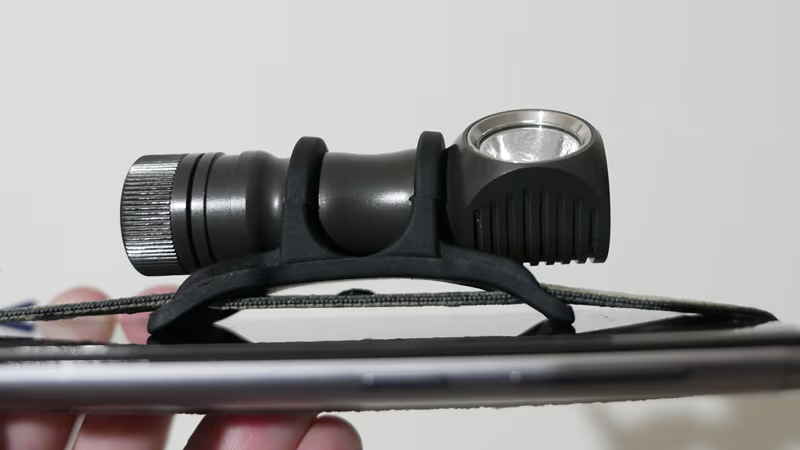
The headband on this headlamp is garbage. Not the headband itself, but the rubber part which bends against the forehead and creates deep red tracks, becoming unbearable after 20 minutes of use. The main cone is too bright, the transition to spill is quite sharp, and it makes the headlamp pretty bad for reading - also, it’s not optimal for outdoor activities: you can point it down and see what is directly in front of you, but you won’t see far; you can point it 5-10m in front of you, but then you don’t see stuff directly in front well, and at higher intensity this light is a bit blinding. Especially on snow.
Here I would actually like a combination of higher total intensity (brightness at the hotspot can be adjusted, but to cover a wider area) and higher battery capacity. I mostly use the headlamp in the 50-150lm range. Then I use the low modes occasionally for night time photography.
Oh, I forgot it has some positives as well. It has six light modes, in theory programmable, but I never bothered. The lowest one (firefly) is enough to light a room so you can see once your eyes adjust. The second one is fine for seeing what is below you, kind of like in full moonlight. The mid ones are fine - one is good for hiking, the other for when you need a bit more light - and the high modes are… well, for when you need a bit more light, but then they are probably not enough.
Specifications
I cannot find the original lumens and runtimes, but I assume they are the same (within rounding error) as for the later model (source, H53c LE):
- High: H1 285 Lm (0.9 hr) or H2 238 Lm (1.6 hr) / 171 Lm (2.3 hrs) / 106 Lm (4.2 hrs)
- Medium: M1 56 Lm (8.5 hrs) or M2 26 Lm (21 hrs) / 10 Lm (41 hrs) / 3.4 Lm (4.5 days)
- Low: L1 1 Lm (13 days) or L2 0.26 Lm (1.1 month) / 0.06 Lm (2.2 months) / 0.01 Lm (3.3 months)
Runtimes are for Eneloop Pro, I have only 1900mAh Sanyo Eneloops and Fujitsu batteries and few 2400mAh Lidl/Tronic batteries.
I’m just not sure which modes are default - from documentation it seems like #1 and #2, with the lower ones being programmable. But differences between modes inside one group are quite noticeable so I assume default modes are first and third from the group. And I would not trust these runtimes too much. On the other hand, I rarely use the high modes. By the way, with fully charged Eneloop battery, highest mode is really bright.
Addendum (2026): ANSI/NEMA FL1 standard defines runtime as time until output drops to 10% of the initial value, so these numbers are meaningless without the actual discharge graph. Nitecore explanation.
Summary
Zebralight H53c does many things right. It’s lightweight (84g with headband and Eneloop NiMH battery), light is relatively warm, pleasant and color rendition is great (humans do not look like a pale zombies, you can clearly recognize cooked meat from raw on a grill), it feels indestrucitble and firefly modes are useful for night time photography or finding a way to toilet/bed without disturbing others.
Run times are not perfect, but with a spare battery it is fine. I assume ones in the table are way too optimistic and high modes can be achieved only when the battery is nearly at full capacity, after which it starts stepping down.
What I really do not like is too narrow main beam which is not optimal for cross-country skiing or reading and its silicone piece holding headlamp attached to headband - either it’s intolerably painful to wear or too lose.
Addendum: In September 2026 i decided to buy replacement (Skilhunt H300 and Wurkkos HD12), hopefully there will be another review. What is surprising, that while this headlamp runs on a single NiMH battery, it can be really bright. Of course it can achieve it only with fully charged battery, but doubling lumen output does not make that much difference. Yes, it does not have crazy modes above 1000lm, but these are not achievable long term. Skilhunt is a bit heavy, Wurkkos is far less bright than Zebralight when running on NiMH battery, also bigger and heavier, Wurkoss HD12 has better headband more comfortable piece attaching headlamp to headband and extra red light and wider cone. So while it fixes issues, light quality is worse (colder with yellow somewhat less satured and shifted towards green - it is not horrible, but noticeable when comparing to daylight or other Hi-CRI lamps)
So while Zebralight headlamp is almost 10 years old, it feels the most durable, lightest, having best light color.